
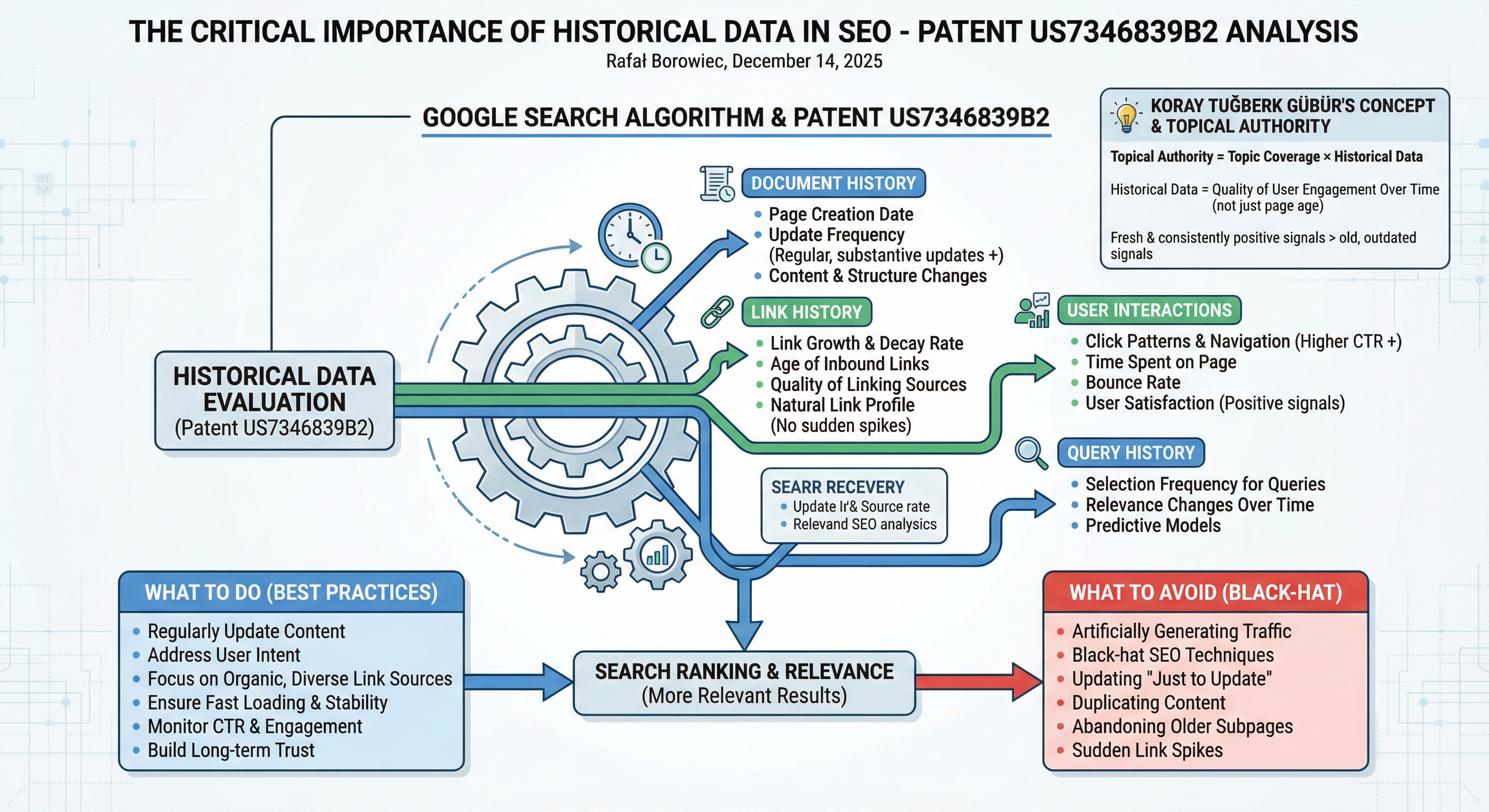
Patent US7346839B2, titled "Information Retrieval Based on Historical Data," describes methods and systems that use historical data to improve the relevance and quality of search results. This is one of the key documents for understanding how Google uses user data and website history to organize search results.
Key takeaways from this article
- Google analyzes document history, links, and user behavior for ranking
- Regular, substantive content updates positively affect rankings
- Sudden link spikes may be considered a spam signal
- Historical data is not page age, but quality of user engagement over time
- Topical Authority = Topic Coverage × Historical Data
What does patent US7346839B2 cover?
The patent focuses on using different types of historical data associated with documents (e.g., web pages) to better match them to user queries.
Main idea of the patent
Based on historical data analysis, the system generates a document score that enables more relevant and personalized search results.
Key elements of the patent
The patent analyzes four main areas of historical data:
Document history
- Page creation date
- Update frequency
- Content and structure change history
Link history
- Link growth and decay rate
- Age of inbound links
- Quality of linking sources
User interactions
- Click patterns and navigation
- Time spent on page
- Bounce rate
Query history
- Selection frequency for queries
- Relevance changes over time
- Predictive models
Significance for SEO
The patent suggests a greater emphasis on long-term activities and analysis of a page's historical effectiveness in terms of both content and link profile.
-
Content freshness
Regular, substantive updates positively affect rankings. Outdated content loses value in the algorithm's eyes over time. -
CTR and user experience
Higher CTR increases perceived page value. User behavior (time on page, engagement) has a direct impact on ranking. -
Natural link acquisition rate
Google prefers organic link profile growth. Sudden link spikes may be considered a spam signal.
Strategic recommendations
What to do
- Regularly update content while maintaining high quality
- Create content that addresses user intent
- Focus on organic, diverse link sources
- Ensure fast loading and technical stability
- Monitor CTR, time on page, and bounce rate
What to avoid
- Artificially generating traffic or clicks
- Black-hat SEO techniques
- Updating pages "just to update"
- Duplicating content
- Abandoning older subpages
Patent US7346839B2 summary
- Create valuable, long-lasting content
- Monitor and adjust strategy based on historical data
- Build long-term trust through quality and natural link profile growth
Koray framework
Koray Tuğberk Gübür's Concept
Koray Tuğberk Gübür emphasizes the fundamental role of historical data in SEO and search engine algorithm operation. His approach extends the patent's conclusions with practical implications.
New definition of historical data
Koray defines historical data not as the mere passage of time since page creation, but as a measure of user engagement quality over time.
This includes all interactions indicating how users perceive the page:
Positive signals
- Long sessions on the page
- Multiple interactions
- High satisfaction
- User returns
Negative signals
- Quick exits
- Lack of engagement
- High bounce rate
- No scrolling
Fresh and consistently positive historical data carries more weight than old, outdated signals.
- Koray Tuğberk GübürTopical authority formula
Koray combines historical data with his topical authority concept:
Topical Authority = Topic Coverage × Historical Data
High topical authority is not possible without a solid history of user engagement
Clearing negative historical data
Important
Negative historical data requires generating new, strong quality signals to "overwrite" previous weak signals. Improving content quality is not enough - you need to systematically build positive interactions.
Best practices
-
Regular updates
Keep content up-to-date and encourage users to return -
Engagement optimization
Focus on page speed, responsiveness, and intuitive navigation -
Content quality
Focus on evergreen content that fully addresses user intent
Final conclusions
- Historical data is the foundation of Google's ranking decisions
- Consistent user satisfaction builds lasting authority
- Strategic content planning over time is key to SEO success
- Avoid artificially inflating metrics - it hurts in the long term