
Patent Metadata
Patent Number: JP2026012740A
Title: Selective generation and/or rendering of ongoing content to complete oral utterances
Applicant: Google LLC
Inventors: David Petrou, Matthew Sharifi
Application Filed: October 10, 2025
Publication Date: January 27, 2026
Status: Pending
The Core Concept
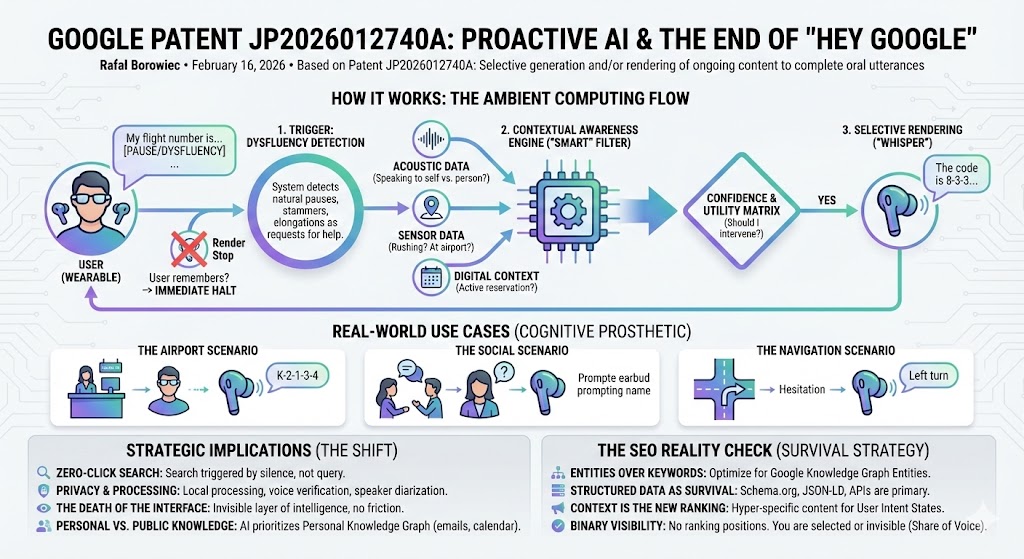
In a significant move toward "Ambient Computing," Google LLC has filed a patent that fundamentally changes how digital assistants interact with humans. Moving beyond the reactive "Hey Google" paradigm, this technology describes a proactive system designed for wearables (smart glasses, earbuds) that listens for human hesitation.
The system detects when a user is struggling to recall information during a natural conversation and "whispers" the answer into their ear-often before the user even realizes they need help.
Technical Breakdown: How It Works
The patent details a sophisticated multi-modal inference engine that decides when to speak and when to stay silent.
1. The Trigger: Dysfluency Detection
The system continuously buffers audio to detect "speech dysfluencies"-the natural pauses, stammers ("um," "uh"), or elongations that indicate a cognitive gap.
Example: "My flight number is... [pause]..."
System Action: The AI recognizes the pause not as the end of a sentence, but as a request for data retrieval.
2. Contextual Awareness (The "Smart" Filter)
Unlike current assistants that blurt out answers, this model uses a Confidence & Utility Matrix to decide if it should intervene. It analyzes:
Acoustic Data
Is the user speaking to a person or talking to themselves?
Sensor Data
Is the user looking at a gate agent? Are they rushing (walking fast)?
Digital Context
Does the user have an active flight reservation in their calendar?
3. Selective Rendering
The patent introduces a "Render Stop" mechanism. If the system begins to whisper the answer ("The code is 8-3-3...") and the user suddenly remembers and starts speaking ("Oh, it's 8339"), the AI immediately halts to avoid talking over the user.
Real-World Use Cases
The patent moves AI from a "search engine" to a "cognitive prosthetic":
The Airport Scenario
You are at the check-in desk. The agent asks for your booking ref. You freeze. The AI whispers "K-2-1-3-4" instantly into your earbuds based on your email history.
The Social Scenario
You are introducing a colleague but forget their name. The system identifies the face (via glasses) or context and prompts the name aurally.
The Navigation Scenario
You hesitate at an intersection. The system detects the hesitation via GPS+Accelerometer and whispers "Left turn" without you asking.
Strategic Implications
1. Zero-Click Search
This represents the ultimate evolution of "Zero-Click" behavior. The user no longer types a query or even asks a question. The "search" is triggered by silence. For the SEO industry, this confirms a future where being the primary entity in a user's Personal Knowledge Graph is the only metric that matters.
2. Privacy & Processing
To handle the privacy concerns of an "always-listening" assistant, the patent emphasizes local processing. Voice verification ensures the system only assists the device owner, and "speaker diarization" filters out background noise, ensuring the AI focuses solely on the user's speech patterns.
3. The Death of the Interface
This technology removes the friction of pulling out a phone. It suggests a future where Google is not an app you open, but an invisible layer of intelligence that fills the gaps in your natural cognition.
The SEO Reality Check: From Keywords to Context
These patents signal a fundamental transformation in how Google intends to serve information. We are moving away from a "Search Engine" that ranks websites to an "Answer Engine" that synthesizes data.
Here are the critical implications for SEO and Digital Marketing strategies:
1. The Rise of "Zero-UI" Search
The patent for completing oral utterances confirms that Google is optimizing for a screenless future.
The Shift: In a world where answers are whispered into an earbud or displayed on smart glasses, there is no SERP (Search Engine Results Page). There are no ten blue links. There is only one answer.
The Consequence: Traditional "ranking" becomes irrelevant. If you are not the primary source of truth in Google's Knowledge Graph, you are invisible. The metric changes from Click-Through Rate (CTR) to Share of Voice.
2. Entities Over Keywords
The "Intermediate Analysis" patent explicitly mentions the model's reliance on "Entity Types" and "Knowledge Graphs."
The Shift
Google is no longer matching string patterns (keywords); it is understanding real-world objects (Entities).
The Strategy
SEO must evolve into Entity Optimization. You must ensure your brand, products, and authors are clearly defined entities in Wikidata and Google's Knowledge Graph. Ambiguity is the enemy.
3. Structured Data as Survival
Because the AI model "thinks" by querying databases and APIs, unstructured text is harder for it to process reliably.
The Shift: Text on a page is secondary. Structured data (Schema.org, JSON-LD) is primary.
The Strategy: You must spoon-feed the AI. Your content must be machine-readable via:
- Comprehensive Schema Markup (FAQ, HowTo, Product).
- Google Business Profile completeness (this is your API to Google).
- Merchant Center Feeds.
4. Context is the New Ranking Factor
The wearable patent highlights that the correct answer depends on the user's location, speed of movement, and calendar.
The Shift: A generic "best hotel" article won't rank for a user standing at an airport terminal. The AI looks for context-specific utility.
The Strategy: Content must be hyper-specific. Optimization needs to pivot to User Intent States: "On-the-go," "Planning," or "Emergency."
5. The Battle: Personal vs. Public Knowledge
The patents describe a hierarchy where the AI checks the user's Personal Knowledge Graph (emails, calendar) before checking the Public Web.
The Consequence
If a user asks "When is my flight?", Google ignores travel sites and checks Gmail.
The Opportunity
Brands must strive to get into the user's personal ecosystem (e.g., getting the user to save a reservation, book a ticket, or subscribe). Once you are inside the user's data loop, you bypass the competitive public web.
6. APIs are the New Link Building
The "Tool Use" patent describes the AI calling external APIs.
The Future: High-authority sites in the future won't just have good backlinks; they will have accessible APIs or data feeds that Google's AI can query directly. Being a "Data Provider" will be more valuable than being a "Content Publisher."
7. Cost of Retrieval Becomes the Core Ranking Mechanism
The patent architecture suggests that answers must be generated instantly, locally, and with high confidence. This makes cost-of-retrieval a primary selection filter.
The Shift: Google will prioritize sources that are easy to parse, factually consistent, structurally clear, entity-disambiguated, and low in ambiguity. Documents that require heavy interpretation increase computational cost.
The Strategy: SEO must optimize for retrieval efficiency, not just relevance:
- One macro-context per page (no topic dilution)
- Clear entity-attribute relationships
- No contradictory claims
- Clean internal linking hierarchy
- Eliminate contextual noise
The question becomes: Is your document cheap enough for Google to select in real-time inference?
8. From "Ranking Positions" to "Entity Selection Probability"
In a Zero-UI environment, there is no visible ranking. There is only selection.
SEO moves from:
- Position tracking
- SERP analysis
- CTR optimization
To:
- Probability of entity selection within a given context
The Consequence: Being #2 is equivalent to not existing.
The Strategy: Increase selection likelihood by:
- Strengthening brand search demand
- Consolidating entity signals across platforms
- Eliminating entity ambiguity
- Becoming the default answer within a contextual niche
Visibility becomes binary.
9. Hyper-Specialization Over Broad Authority
Large sites historically won by covering broad topic areas. In contextual ambient search, specificity wins.
The Shift: A deeply specialized, context-dominant entity can outrank a broader authority if it is more precise for the user's real-time situation.
Instead of building:
"Travel Website"
Build:
- "Airport Emergency Accommodation Authority"
- "Last-Minute Business Travel Entity"
Micro-authority within defined intent states becomes more valuable than generic domain authority.
10. Conversational Relevance Modeling
The system detects incomplete sentences and conversational context. This introduces a new variable: spoken language optimization.
The Shift: Content must align with how humans hesitate, pause, self-correct, and speak naturally. Not how they type.
The Strategy: Optimize for:
- Conversational syntax
- Natural sentence completions
- Direct, interruption-resistant answers
- Structured short responses extractable mid-sentence
The AI must be able to inject your answer seamlessly into a live conversation.
11. Knowledge Graph Consolidation > Content Volume
In an answer-first system, Google does not need 200 similar articles. It needs one trusted node in the Knowledge Graph.
The Shift: Publishing more content does not increase visibility. Strengthening entity consolidation does.
The Strategy: Focus on:
- Entity consistency across web properties
- Structured citation alignment
- Knowledge Panel reinforcement
- Brand-author-person-product relationship clarity
Fragmented entity signals reduce selection probability.
12. The Emergence of "State-Based SEO"
Traditional SEO optimizes for static queries. This patent signals optimization for dynamic user states.
The Shift: The same query may produce different answers depending on movement speed, location, social setting, calendar proximity, and cognitive hesitation.
The Strategy: Build content mapped to user state clusters, not just keywords:
- Pre-transaction
- Mid-transaction
- Social introduction
- Time-sensitive
- Location-sensitive
- Urgency-driven
SEO becomes behavioral modeling.
13. First-Party Data Becomes Strategic Leverage
If Google prioritizes the Personal Knowledge Graph, brands must integrate with it.
The Shift: Owning the relationship with the user becomes more powerful than ranking publicly.
The Strategy: Encourage:
- Account creation
- Email confirmations
- Reservation storage
- Calendar integrations
- App installs
If your brand is stored in the user's personal data layer, you bypass the competitive public web.
14. Binary Visibility Replaces Traffic Scaling
Under ambient computing:
You are selected
You do not exist
There is no incremental scaling from position 5 → 3 → 2 → 1.
The Implication: Traffic volatility will increase. Visibility becomes more polarized.
The Strategy: Invest in:
- Authority consolidation
- Contextual precision
- Entity trust signals
- Data accessibility
SEO becomes more defensive and structural.
Summary
The direction is clear. Google is building an intermediary layer between the user and the web. To survive, SEOs must stop optimizing for human eyes (reading long text) and start optimizing for machine logic (structured entities, APIs, and clear facts).
- Zero-UI search is the future - be in the Knowledge Graph or be invisible
- Entities over keywords - structured data is survival
- Context-specific content beats generic articles
- Personal knowledge graphs take priority over public web
- APIs and data feeds are the new link building