
Patent Metadata
Patent Number: US12536233B1
Official Title: Machine-Learned Content Page Generation and Landing Page Scoring System for Search Result Optimization
Applicant: Google LLC
Inventors: Caren Zeng, Rushil Grover, Timothy Benjamin Whalin, Lauren Marjorie Bedford, Pallavi Satyan, Ethan Milo Mann
Filing Date: January 3, 2025
Publication Date: January 27, 2026
Status: Granted
What is the Patent About?
Core Problem
The patent addresses inefficiencies in how landing pages are presented and navigated following a user query. Traditional landing pages often fail to align with user intent, suffer from poor usability, and lack adaptive content presentation. This leads to low engagement, poor conversion, and suboptimal user satisfaction.
Invention Overview
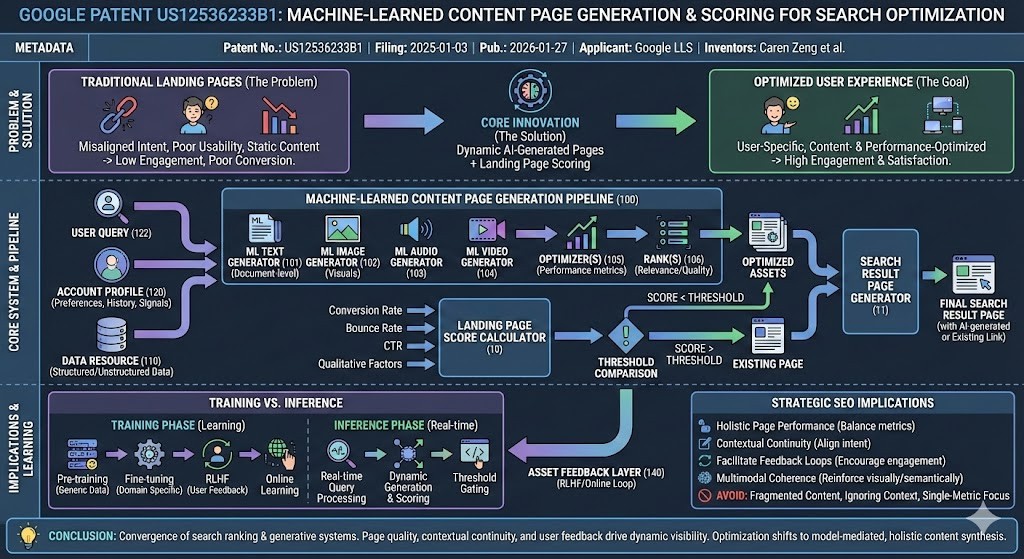
The system introduces a machine-learned content page generation pipeline that dynamically produces AI-generated landing pages based on user queries, contextual data, and behavioral signals. It integrates a landing page scoring mechanism to evaluate existing pages and determine whether an AI-generated page should be presented instead.
The architecture combines generative content models (text, image, audio, video), optimization and ranking modules, and feedback-driven refinement loops. The outcome is a dynamically generated, user-specific landing experience that is both content- and performance-optimized.
Key Patent Elements
1. Machine-Learned Content Page Generation Pipeline (100)
Function: Centralized orchestration layer for generating multimodal content assets.
Inputs: Data resource (110) and account profile (120).
Outputs: Optimized, ranked, and user-personalized content assets.
Scope: Document-level generation.
Relevance: Establishes a generative model-driven approach to landing page construction, suggesting document-level comprehension and synthesis capabilities akin to transformer-based architectures.
2. Machine-Learned Text Generator (101)
Role: Generates textual assets for landing pages.
Inputs: Structured/unstructured data from data resource (110) and user context from account profile (120).
Outputs: Text asset(s) (1104A).
Mechanism: Likely transformer-based, operating at document-level granularity.
SEO relevance: Enables contextual text generation aligned with query and user history, implying document-level semantic relevance modeling.
3. Machine-Learned Image Generator (102)
Role: Produces visual assets aligned with the textual narrative.
Inputs: Same as text generator.
Outputs: Image asset(s) (1104B).
Relevance: Suggests multimodal coherence between textual and visual elements.
4. Machine-Learned Audio (103) and Video (104) Generators
Role: Extend content generation into richer media formats.
Scope: Document-level, though underspecified.
Implication: Indicates potential for multimodal landing page experiences beyond static text/images.
5. Optimizer(s) (105)
Role: Apply optimization algorithms to generator outputs.
Inputs: Outputs from generators (101–104).
Outputs: Optimized assets.
Relevance: May adjust for performance metrics, engagement probability, or conversion likelihood.
6. Rank(s) (106)
Role: Rank generated outputs based on relevance or quality.
Inputs: Generator outputs.
Outputs: Ranked asset set.
Relevance: Provides a quality-control mechanism before presentation, potentially analogous to ranking layers in search retrieval systems.
7. Data Resource (110)
Role: Supplies structured and unstructured data for content generation.
Relevance: Serves as the factual grounding base for generative models.
8. Account Profile (120)
Components:
- User preferences
- User query (122)
- Previous searches (124)
- Past signals/controls (126)
Role: Contextualizes generation to individual user behavior.
Relevance: Enables personalization and contextual continuity across sessions.
9. Asset Feedback Layer (140)
Role: Collects user feedback on generated assets and triggers regeneration or refinement.
Relevance: Implements reinforcement learning from human feedback (RLHF) or online learning loops.
10. Landing Page Score Calculator
Inputs: Conversion rate, bounce rate, CTR, qualitative factors (design/content quality), performance metrics.
Output: Scalar landing page score.
Relevance: Quantifies landing page quality for decision-making.
Scope: Document-level.
11. Search Result Page Generator
Role: Generates both initial and updated search result pages.
Inputs: User query, landing page score, threshold value.
Output: Search result page (potentially with link to AI-generated page).
Relevance: Connects ranking and generation systems; conditionally introduces AI-generated alternatives when existing pages underperform.
Training vs Inference
Training Phase:
- Pre-training (22): Generic model initialization using large-scale data.
- Fine-tuning (24): Domain- or organization-specific adaptation.
- Reinforcement learning (26): User feedback loop via asset feedback layer (140).
- Online learning (36): Continuous refinement through federated or on-device feedback.
- Optimization stages (29-1 through 29-4): Apply computational efficiency and gradient-based parameter tuning.
Inference Phase:
- Real-time processing of user query + contextual data → AI-generated page.
- Landing page score computation and threshold gating occur here.
- Ranking and optimization modules operate in deterministic or semi-learned mode.
- All behavioral and performance signals (conversion, bounce, CTR) are active.
Significance: This distinction clarifies that generation and ranking decisions are inference-time processes, while quality improvement and personalization refinement occur during training and online learning.
SEO Implications
Document-Level Understanding
The system evaluates entire landing pages (not fragments) using behavioral and qualitative metrics. This implies that page-level integrity - design, content coherence, and performance - directly influence the computed landing page score.
User-Centric Contextualization
Integration of user query history and preferences suggests a contextual retrieval and generation model, aligning with intent continuity and personalization trends.
Feedback-Driven Optimization
The presence of the asset feedback layer and reinforcement learning indicates that user engagement feedback loops can directly influence future content generation quality.
Threshold-Based Replacement Logic
Poorly performing landing pages may be substituted or supplemented by AI-generated alternatives, implying a performance-contingent visibility mechanism.
Strategic SEO Recommendations
What to Do:
- Optimize for holistic page performance: Ensure balanced metrics across conversion, bounce, and CTR since all feed into the landing page score.
- Preserve contextual continuity: Maintain semantic consistency between query intent, page content, and linked assets to align with contextual modeling.
- Facilitate feedback loops: Encourage user interactions that can be captured as positive signals (e.g., engagement with CTAs, dwell time).
- Design for multimodal coherence: Text, images, and videos should reinforce each other semantically and visually.
What to Avoid:
- Fragmented or inconsistent content: Disjointed sections may lower qualitative content scores.
- Ignoring user context: Static landing pages that disregard prior query or session history risk being replaced by AI-generated alternatives.
- Over-optimization for one metric: Focusing solely on CTR without improving design or content quality may not improve the composite landing page score.
Why This Patent is Important for SEOs - and What it Could Change in SEO
1. It Merges Ranking With Generation
This patent (US12536233B1) represents a structural shift: search ranking and AI content generation are no longer separate systems.
Traditionally:
- Google ranks existing landing pages.
- Website owners optimize those pages.
- Search results display links to third-party sites.
In this architecture:
- Google evaluates the landing page.
- If it underperforms (based on behavioral and qualitative metrics),
- Google can generate a machine-learned alternative landing page.
That means the search engine is no longer just a ranking system - it becomes a content producer and optimizer at inference time.
This changes the power balance between publisher and search engine.
2. Document-Level Evaluation Becomes Critical
The patent emphasizes:
Conversion rate
Bounce rate
CTR
Design and qualitative metrics
Behavioral feedback loops
This implies that entire landing pages are scored holistically, not just fragments or keyword matches.
From an SEO perspective, this aligns strongly with principles of:
- Semantic coherence
- Contextual hierarchy
- Macro and micro semantics
- Document-level consistency
This patent operationalizes that idea algorithmically.
If a page is:
- Contextually fragmented
- Behaviorally weak
- Semantically inconsistent
- Poor in engagement signals
…it may be replaced.
3. Threshold-Based Replacement Is the Real Disruption
The most disruptive part is the threshold gating mechanism.
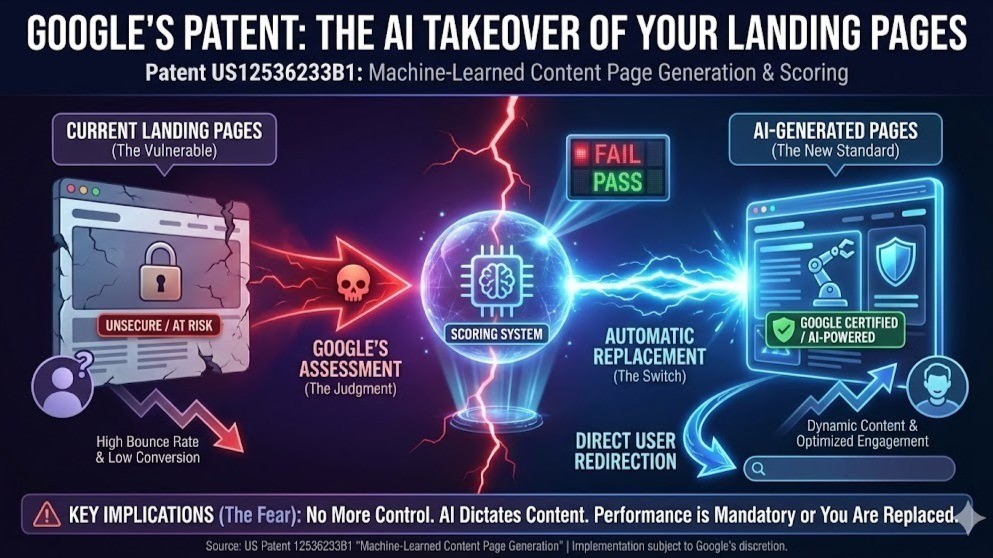
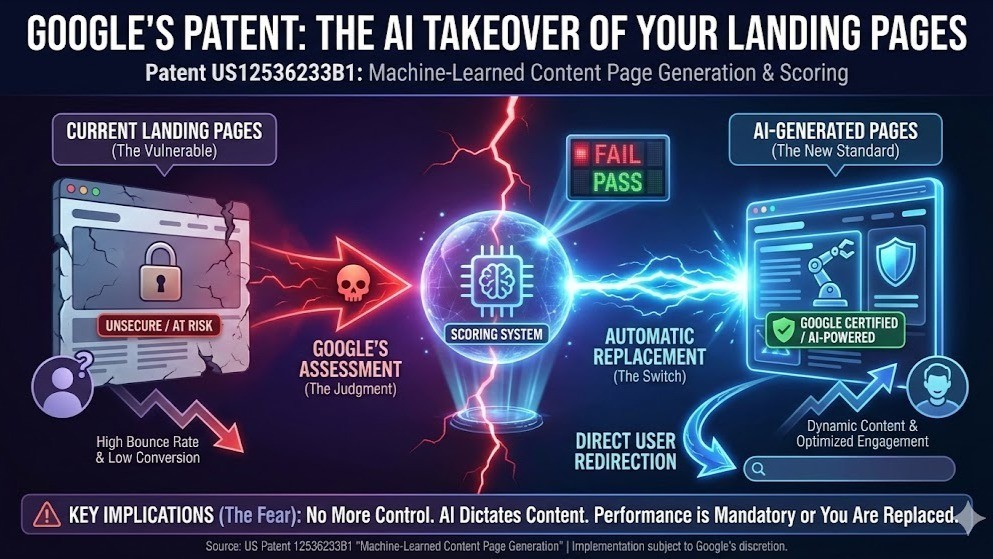
If: Landing Page Score < Threshold → Show AI-generated page instead.
This introduces a new reality:
Your ranking position may no longer guarantee visibility.
Even if you rank #1:
If your landing page score is low,
Google could inject a generated alternative experience.
That means SEO is no longer just about ranking - it becomes about retaining eligibility for display.
4. Behavioral Signals Become Structural Inputs
The architecture from the patent includes:
Asset Feedback Layer (140)
Reinforcement learning loops
Online learning
Federated/on-device feedback
This makes user engagement not just a ranking signal, but a training signal!
This patent confirms that direction:
- Historical engagement
- Ongoing feedback
- Behavioral consistency
All influence content prioritization.
SEO shifts from static optimization to behavior-driven model compatibility.
5. Multimodal Coherence Will Matter More
The patent integrates:
Text generator
Image generator
Audio generator
Video generator
This suggests that future landing experiences may be:
- Dynamically assembled
- Query-specific
- Multimodally optimized
This reinforces the importance of macro and micro semantics in content structuring.
If multimodal assets must align semantically:
- Visual-text mismatch
- Random media placement
- Context dilution
…could reduce landing page scores.
Final Takeaway
This patent signals a transition from:
Ranking Web Pages
Ranking + Generating + Replacing Landing Experiences
Search and generation are converging into a unified adaptive system.
If this architecture is deployed widely:
- SEO will depend less on static ranking factors
- More on document-level semantic integrity
- Behavioral reinforcement
- Multimodal coherence
- Retrieval efficiency
- Historical engagement quality
Summary
This architecture represents a convergence between search ranking systems and generative content systems, where landing page evaluation and AI-based content creation operate in a feedback loop.
The system's core innovation lies in document-level generative adaptation - pages are not only evaluated but can be autonomously regenerated based on performance thresholds.
For SEO strategists, this indicates a structural shift: optimization is no longer limited to static ranking factors but extends into dynamic, model-mediated content synthesis, grounded in user behavior and feedback.
Optimization becomes less about gaming signals - and more about becoming the lowest-cost, highest-clarity, highest-responsiveness information node in a topic graph.